
As your fertility doctor, I can help you to understand your natural fertility and improve your chances of a natural conception with expert advice.
If your preference is to avoid IVF as much as possible, I will work with you to optimise your natural fertility to help you try to conceive naturally. For many couples, all it takes is the right guidance and an in-depth understanding of how your fertility works.
Much of maximising your fertility will also improve your general health. A lot of factors in your environment or lifestyle can have detrimental effects on both male and female reproductive health, reducing your chances of a positive pregnancy test.
Your diet impacts many aspects of your health, and one of these is your fertility. A well-balanced, nutritious diet is important both for preconception health and also during pregnancy. Foods that promote healthy fertility include seafood rich in omega-3 oils, lean proteins, particularly plant-based proteins, whole fruit and vegetables, wholegrains such as oatmeal, and legumes. Avoid refined white carbohydrates, animal fats, and ultra-processed foods.
Body weight outside of the recommended range, whether over or under, can affect your hormonal balance, which in turn, impacts your reproductive system. Women who are underweight or overweight are more likely to experience infertility and have complications during pregnancy, and similarly, obesity in men can affect sperm quality and quantity. Being overweight can also increase the likelihood of an unsuccessful IVF cycle.
To support both your preconception health and a healthy pregnancy, it’s important that you limit alcohol when trying to fall pregnant to minimise any detrimental effects on egg and sperm quality Similarly, cigarette smoking can cause reduced sperm quality and quantity in men. Illicit drug use has also been associated with infertility.
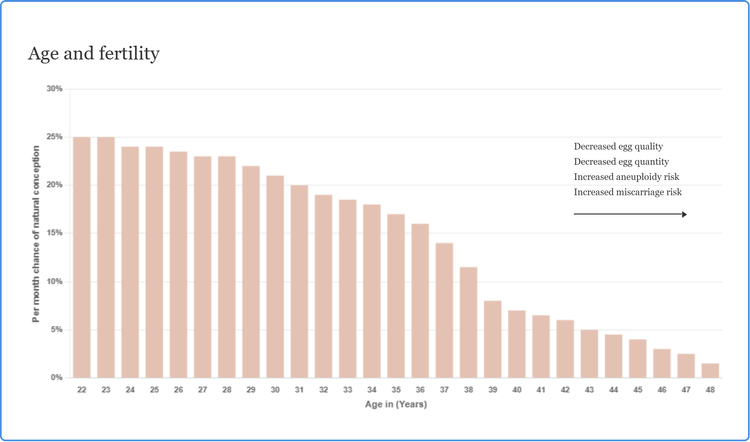
Though you may follow all the recommendations above to the letter, you can’t stop ageing. In women, age is the single most significant determinant of your fertility. This is because at birth, all the eggs you will ever produce are already present. At birth, a woman’s egg count is typically around 1 to 2 million. By puberty, this number has decreased to 300,00 to 500,000, and continues to drop every month with ovulation.
Peak female fertility is in the mid-20s, where your chance of falling pregnant each month is 20-25%. This is in contrast to a woman in her 40s, where the odds of conceiving are around 5%.
Although men continue to produce new sperm throughout their lives unlike women and eggs, the quality of the sperm tends to decrease with age. This results in increased difficulties in conceiving or miscarriage, and can also raise the likelihood of medical, psychiatric, or developmental concerns in children.
Timing intercourse with your partner during your fertile window can boost your chances of conceiving. Contrary to popular belief, it is not possible to fall pregnant on simply any day of the month – the egg needs to be available for fertilisation. The fertile window refers to the 5 to 7 days prior to ovulation up to the day after.
Use the ovulation calculator to gain an estimate of when to expect your next fertile window.